
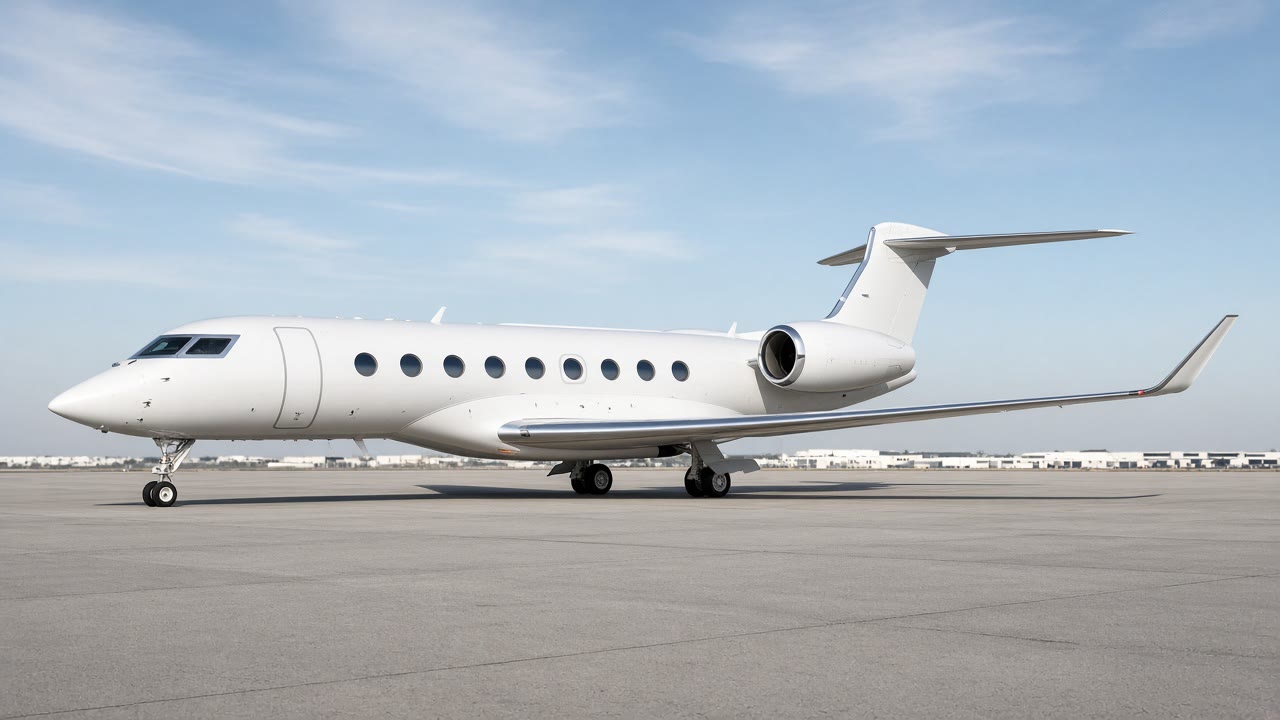





The official print
On 28 May 2026 the General Aviation Manufacturers Association published the first-quarter shipment and billing report; the PDF on gama.aero is the 1 June update. Business jets: 162 units, against 141 in Q1 2025, +14.9%. Airplane billings: $6,065,449,611, +19.1%. Total airplane shipments: 667, +6.4% on 627. The mix underneath is the familiar post-pandemic shape — pistons 381 (+6.4%), turboprops 124 (−3.1%), jets doing the value work. Helicopters in the same file are 168 civil units. Those are factory counts, not flight hours, and they are the right place to start any 2026 OEM conversation.
If Q1’s jet pace held for four quarters, 2026 would annualise near 650 jets. GAMA’s 2025 year was already 854.
AvBuyer’s June analysis of the same tables is useful for OEM colour and should be labelled as trade press, not as a second GAMA release. Gulfstream led the jet makers at 38 units (36 in Q1 2025). Textron’s Cessna unit shipped 37, up from 31. Embraer rose 26.09% from a 23-unit Q1 2025. Seven of nine reporting jet OEMs were up; one was flat; one was down a single aircraft. Airbus Corporate Jets appears in the GAMA PDF with one ACJ320neo; Boeing Business Jets with zero. The rank order is a Q1 snapshot. It is not a full-year forecast.
2025 was already the reset year
GAMA’s public 2019–2025 series puts last year in context. Business jets: 809 (2019), 644 (2020), then a grind back through 710, 712, 730, 764 and finally 854 in 2025 — +11.8% on 2024, the series high. Airplane billings: $23.5 billion in 2019, $20.0 billion in 2020, $31.0 billion in 2025 (+16.1% on 2024). The industry is not “returning to 2019.” On dollars it has already gone through 2019. On units it has passed 2019’s 809 jets. Honeywell is explicit that it does not expect a replay of 2008’s 1,300-jet year; the 34th outlook’s working image of a new normal is closer to 900 jets a year later in the decade. Q1 2026’s 162 is compatible with that path. It is not a bubble print.
Honeywell’s 2026 call, tested against the tape
The October 2025 Honeywell newsroom release is still the public outlook everyone cites: 8,500 deliveries and $283 billion over the next ten years, 3% average annual growth, 2026 deliveries 5% above 2025, North America about 70% of the next three years of units, Europe 14%, Latin America 7%, Asia-Pacific 5%, Middle East and Africa 3%. A 5% year on 854 jets is about 897 — squarely in Honeywell’s “new normal” language. JETNET/WINGX’s estimated 544 deliveries year-to-date through July, +9.2%, with North America at 86% (468 units), is a different counter and a different window. It cannot be subtracted from GAMA. It does say the first seven months did not break the outlook.
The backlog is the 2027 number
Global Jet Capital’s Q2 brief is the cleaner “five main OEM” backlog: $66.8 billion, +20.4% year over year, book-to-bill above 1, lead times 18–26 months, H1 deliveries for those five names +4.5%, Q2 “nearly even” with Q2 2025. JETNET/WINGX’s four-OEM backlog is $61.6 billion, Gulfstream and Bombardier almost 75% of it, Bombardier’s own book +35.4%, Q2 book-to-bill 1.5× at Bombardier and Gulfstream and 1.1× at Embraer. Do not mash $66.8 billion and $61.6 billion into one statistic. Do notice that both are decade-high order books and both push production visibility into 2027–28. A charter buyer shopping a new large-cabin slot in September 2026 is not buying 2026 metal. They are buying a queue.
Why Q2 GAMA is the next hard check
GAMA listed 1–2 September 2026 as the confirmed Q2 release window. This scan did not find the Q2 PDF on the quarterly shipments page. That matters because GJC already warned that Q2 factory output, for the five names it tracks, was only in line with last year even as the first half stayed +4.5%. A GAMA Q2 that stays in the mid-teens year-over-year would support Honeywell’s 5% full-year call and AvBuyer’s “record year ahead?” headline. A GAMA Q2 that goes flat would say Q1 borrowed from the rest of the year. Until the PDF exists, treat 162 as a first-quarter fact, not as a run-rate.
What a broker should take from the factory
For an independent charter desk the OEM tape is not a buying signal. It is a mix signal. New deliveries concentrated in large-cabin and program fleets tighten the retail pool of late-model super-mids and heavies. Tight young-aircraft inventory (GJC: 12-year-and-newer availability 3.7% of fleet at the end of Q2) keeps managed charter rates supported even when branded-charter hours soften. Light and midsize metal — the empty-leg majority — will keep turning because that is how those aircraft earn. The 162-jet quarter says the industry can still make airplanes. The backlog says the next ones are already spoken for. The activity split, in the companion piece, says who is speaking for them.